
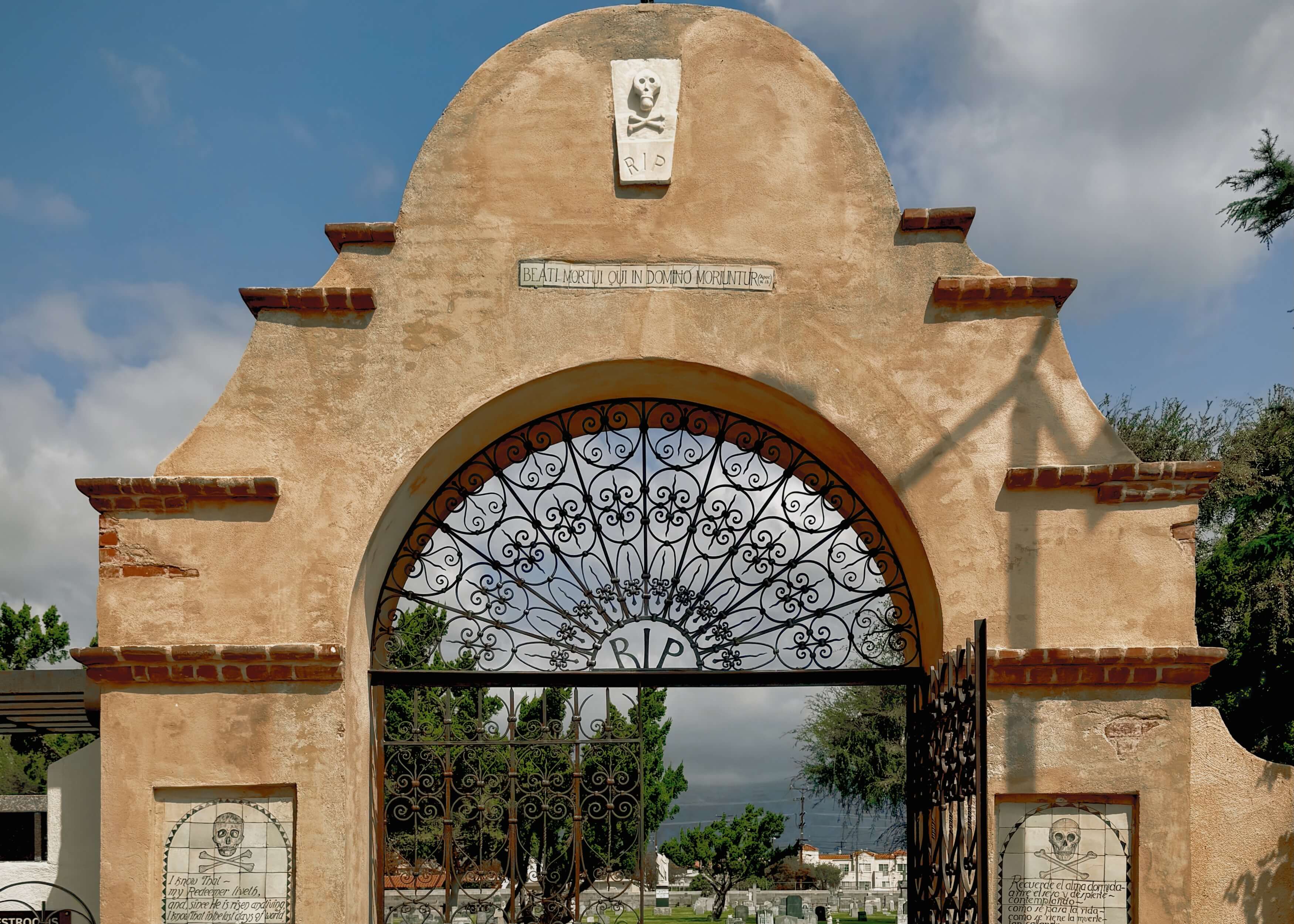
Looking for a peaceful little getaway from the week's cares and hassles? I know it sounds macabre, but tranquility awaits you within the walls of Mission San Gabriel's dual Campo Santos.
Like many history buffs, I find old cemeteries oddly soothing and profoundly educational. Walking among the plots and statuary, you never know who you'll stumble upon. Plus, you can’t help but muse on mortality and the many life stories lost to time. It's as much a philosophical pursuit as a historical one.
Like many history buffs, I find old cemeteries oddly soothing and profoundly educational...
For this little tour of the Great Beyond, postpone any excursions through the "original" Campo Santo within the mission's courtyard walls. Although that small cemetery, consecrated in 1778, contains some 6,000 to 7,000 souls, only a handful of mission-era graves are marked. A frequent mission custom was to bury the dead in a large common area or pit. In some cases, families with the stature and resources might later retrieve a loved one’s bones for reburial in a separate plot or charnel, but individual grave markers weren’t considered particularly important. The Catholic missionaries recorded deaths and burials in the Church sacramental registers, and that’s what mattered.
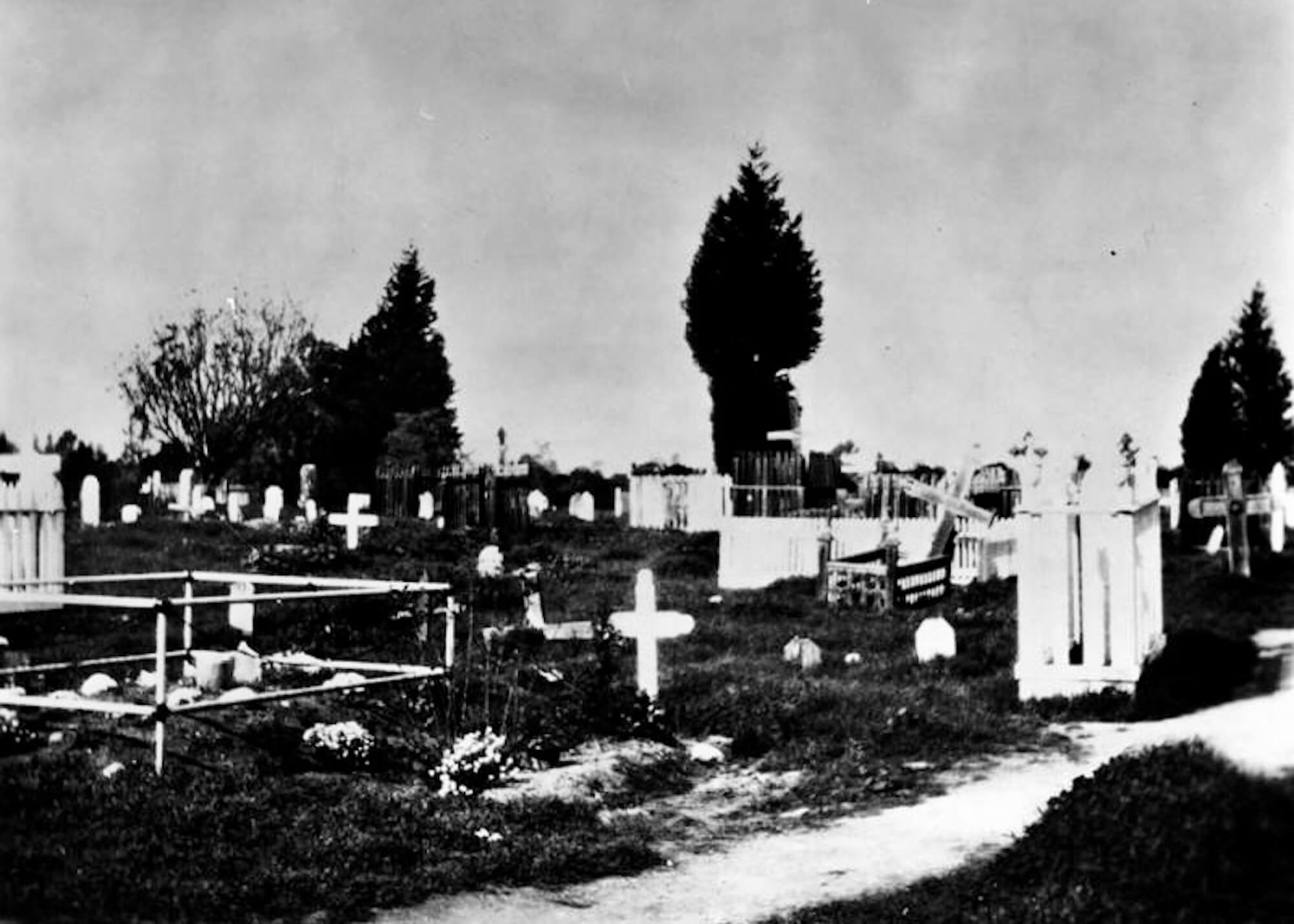
To see good old-fashioned tombstones and sculpted angels, you'll have to head across the parking lot toward the parish's second church and pass through the skull-adorned archway to the “newer,” larger cemetery. Burials here date from the mid- to late-1800s onward, and you’ll find many old Californio names like Lugo, Felix, Verdugo and Ortega. Most of their monuments are simple and unassuming, belying these families’ importance to the L.A. region’s early development.
The Older Graveyard
Once you've read enough inscriptions, go back, pay the admission fee, and wander the older graveyard, museum and gardens of L.A.'s "Mother Church.” Dedicated to the Archangel Gabriel on September 8, 1771, along the banks of the Rio Hondo near the Whittier Narrows, the fledgling mission experienced heavy flooding, forcing the padres to relocate it to the present site by May 1775. The fourth in California's growing chain of 21 missions, it later ranked among the most prosperous, with ranch lands stretching to the San Bernardino Valley.
A handful of iron crosses, concrete vaults and small headstones are the only clues to the thousands of indigenous neophytes buried here...
Almost all the gravestones in its tiny Campo Santo belong to priests and religious of the Claretian congregation, which has administered the modern mission parish since 1908. (The Franciscans who died serving the mission between 1803 and 1850 are buried inside the church at the altar—another early custom.) You’ll also find the grave of the renowned Southern California historian and genealogist Thomas W. Temple II (1905-1972) near the remnants of the church’s first bell tower, which an 1812 temblor toppled. A handful of iron crosses, concrete vaults and small headstones are the only clues to the thousands of indigenous neophytes buried here throughout the mission’s history.
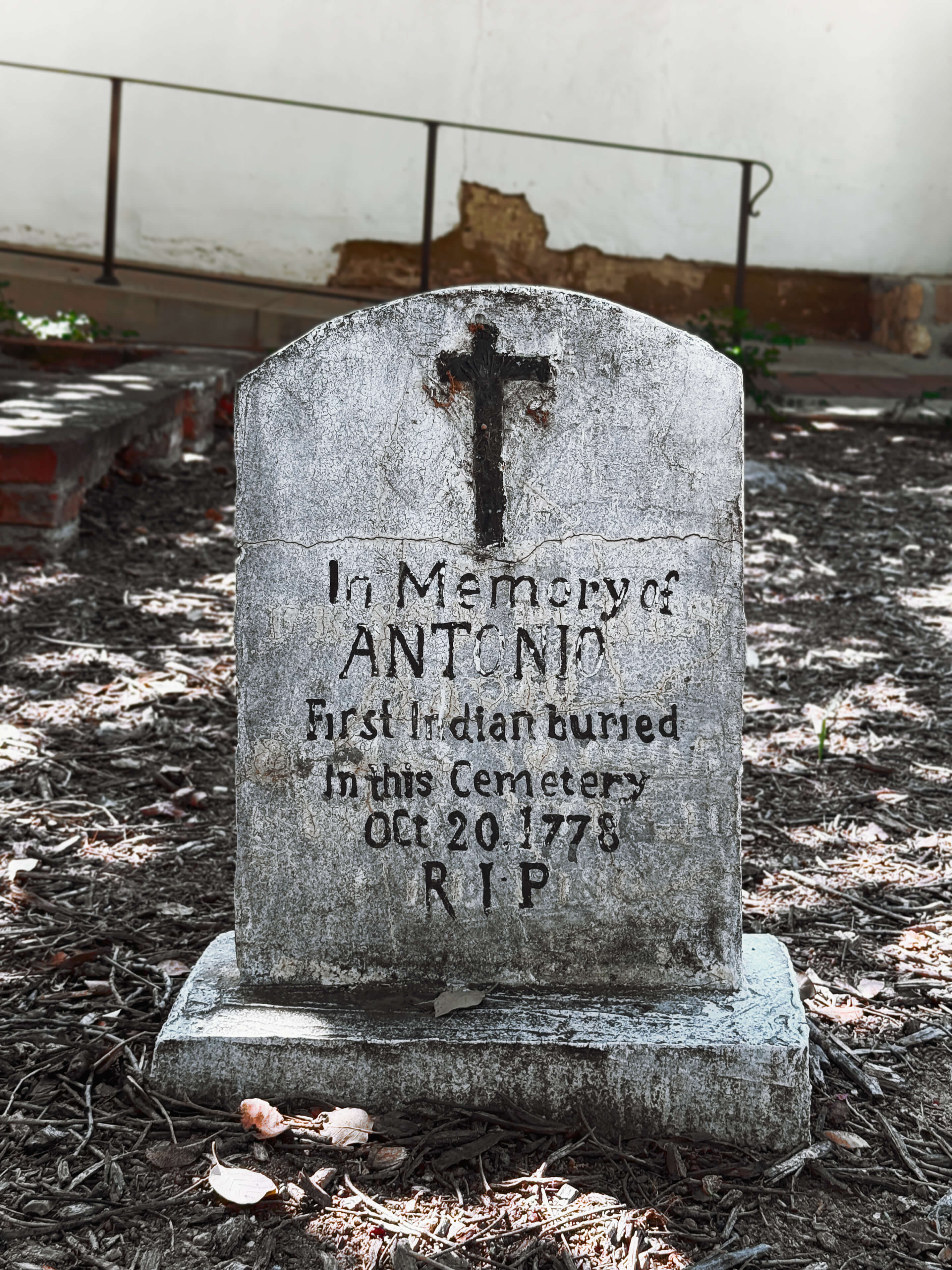
Perhaps the most notable monument commemorates Antonio, the graveyard’s first occupant. A search of the Early California Population Project database confirms that he was an indigenous adult buried on October 20, 1778, in the “Cementerio de esta Misión.” This wording in the mission's death register differs from earlier entries that roughly translate to “buried from the church,” signaling the shift to the newly consecrated cemetery with his passing.
But this raises an intriguing question: Mission San Gabriel’s death entries run uninterrupted from the settlement’s Rio Hondo days, through its relocation, to the eventual consecration of this Campo Santo. So where at the new mission site did they inter everyone who died from 1775 through most of 1778? One possible answer came in 2014 when a working crew unearthed Native American remains while lowering the railroad tracks fronting the mission.
...[W]hatever this burial place lacks in chiseled biographies, it more than makes up for in charm...
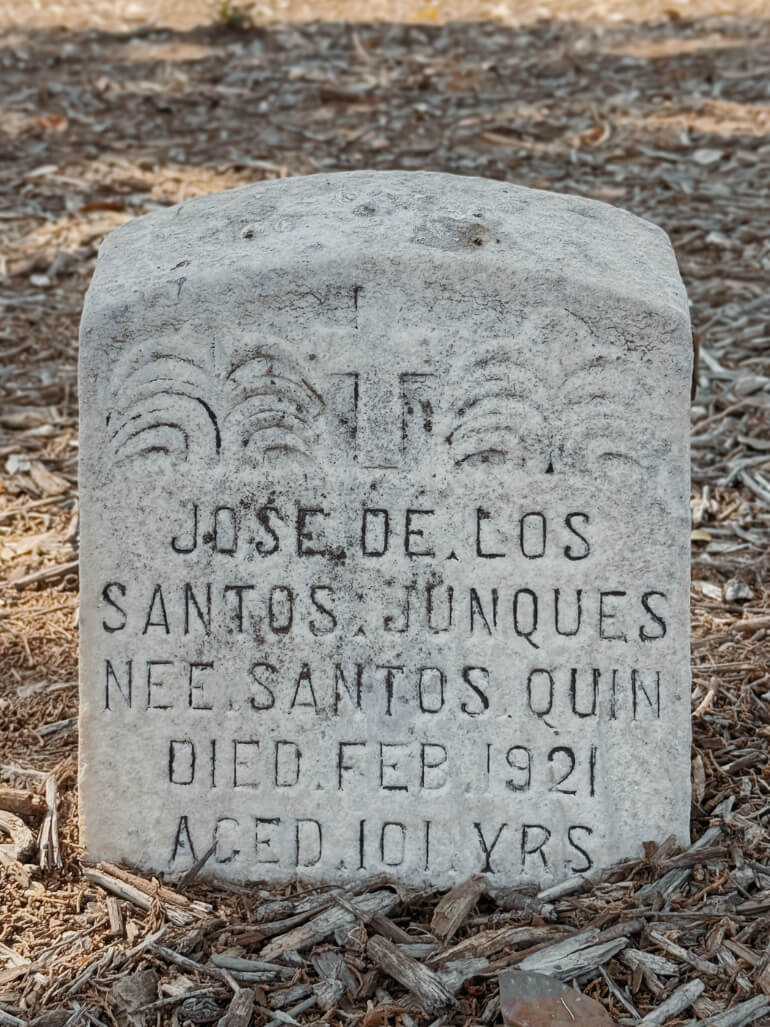
Near Antonio’s memorial, you’ll also see a smaller white gravestone bearing the name “Jose de los Santos Junques nee Santos Quin.” He died in February 1921, apparently at the impressive age of 101. However, sources disagree on his vital statistics. Most list his surname as Juncos, and the National Park Service suggests he died younger, while others confirm his centenarian status. Regardless of his exact age and name, Juncos was a respected Juaneño who later in life served as a key ethnographic source for researchers.
As far as this graveyard's epitaphs go, those of Antonio and Juncos are arguably the most historically interesting. But whatever this burial place lacks in chiseled biographies, it more than makes up for in charm. A rustic grape arbor shades the main pathway, and colorful, tiled Stations of the Cross line the garden's perimeter. The graveyard's centerpiece is a large stone-based crucifixion scene. The peaceful setting can leave you reflecting on the several thousand untold indigenous tales contained here—an ironic and sad reminder of the extensive disease and death that accompanied Spain’s effort to Christianize Alta California.
Faithful Restoration
Similar to other Spanish missions, San Gabriel has seen plenty of ups and downs since its founding. In recent years, the 1987 Whittier earthquake forced the Moorish-inspired church to close for lengthy restoration and seismic retrofitting. Then, in July 2020, an arsonist torched the structure. Damage was extensive, and another $8-million restoration took roughly three years to complete.
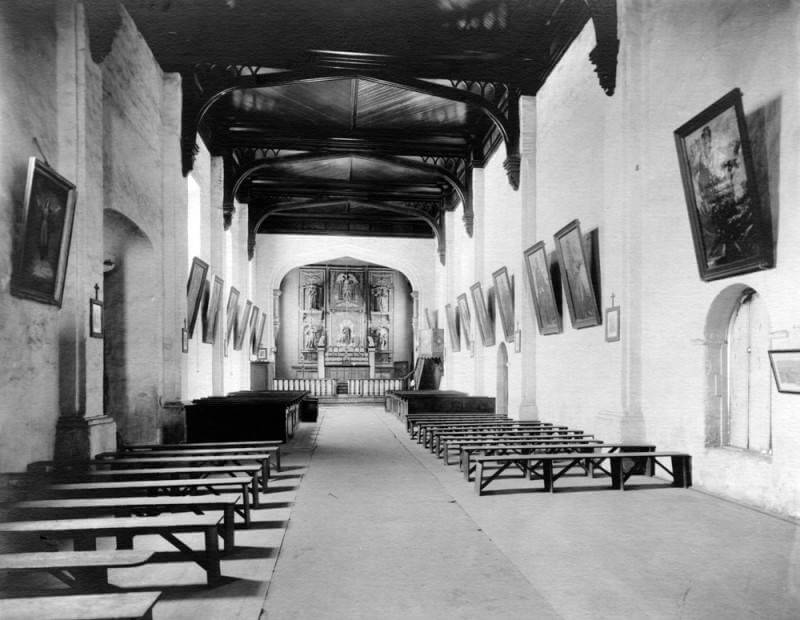
It was money and time well spent. The whitewashed church interior has shed an anachronistic 1950s-1960s paint scheme for a more historically accurate ambiance, complete with a beautifully restored redwood ceiling unique among the California missions.
The peaceful setting can leave you reflecting on the several thousand untold indigenous tales contained here...
The updated museum, exhibits and courtyards also deliver a much more nuanced interpretation of mission life and its complexities. A Native American Garden offers a glimpse of the region's landscape before European arrival, and the San Gabriel Band of Gabrieleño Mission Indians has contributed two large models of traditional kiiy dwellings representing their cultural heritage. Another Gabrieleño exhibit is currently in the works.
Still, what’s left of this once-sprawling mission complex is minimal, so you can easily complete your entire tour in a couple of hours or less, depending on your pace. Afterward, you'll discover eats and refreshments in the City of San Gabriel's modest Mission District, a quick stroll from the mission's iconic six-bell campanile and rectory.
Along the way, glimpses of a grapevine descended from original mission stock (which once comprised Early California’s most renowned vineyard), the nearby Mission Playhouse (historic in its own right), and La Casa Vieja de Lopez (one of the region’s earliest surviving adobe homes) round out your adventure. Enjoy!
Location: 429 S. Junipero Serra Drive, San Gabriel, CA 91776